Master’s in Food Technology

What to expect
Facts & figures- Food, Technology
- Full-time
- 2 years
- English
- Wageningen
Is this master’s right for me?
With the constant increase in the global population, it is crucial to address issues such as food shortages, food preservation and distribution, and quality management of food products. In current times, society needs more experts in this field. The Master’s in Food Technology at Wageningen University & Research is considered one of the most innovative and competitive programmes in the world.
What makes this programme unique?

Design your own path
Create your ideal study route by choosing electives that match your interests, from sustainable production to enzyme technology or product development.

Join a global network
Study at a top university while being part of an international ecosystem of collaboration with leading experts, researchers and innovative companies.

Cutting-edge research environment
Benefit from Wageningen’s world-class facilities and research excellence, where scientific discovery meets practical application in food technology.

From science to practice
Apply your knowledge directly to real innovations through your thesis and international internship, even within top companies of the global food sector.
What you will learn
During this master’s you will take a deep dive into the science behind food production, process, and innovation. You will acquire technological knowledge and practical skills to analyse food and develop innovative and sustainable food products.

You will learn
- How to influence food structure and properties through processes such as fermentation, drying, and emulsification.
- How to develop new or improved products using enzymes and micro-organisms.
- How to apply technology to make food products safer, healthier, and more sustainable.
- How to translate consumer behaviour and market insights into product innovation.
- How to independently investigate and solve a technological problem, from hypothesis to conclusion.
Your courses
The MSc in Food Technology a full-time two-year programme, fully taught in English, and the only programme of its kind at university level in the Netherlands. In 2025 for the 20th time in a row, Wageningen University & Research was ranked by students to be the best university in the Netherlands.
Our university provides excellent education to students from around the world. Representing more than 100 nationalities, Wageningen University & Research offers a unique international character. Students not only contribute to the sustainable development goals, but also to an active, dynamic student life.
For more information about this master's profile and learning outcomes, check the Study Handbook.
During the first year, students follow a set of core Food Technology courses. These provide a solid foundation for other courses, that are based on individual preferences and interests. Core courses deal with the fundamentals of Food Technology, domain courses provide a wide variety of topics in the field. On top of those, students are free to add (cross-disciplinary) elective courses. All students follow the integrative course Product and Process Design. This way students are provided the opportunity to develop their own profile, and become the food scientist that they want to become.
The second year is divided into a thesis (36 ECTS) and an internship (24 ECTS), building upon the courses from the first year. The thesis will take place at Wageningen University, and takes approximately 6 months to complete.
Thesis
Students typically perform their thesis at one the following chair groups: Food Chemistry, Food Physics, Food Process Engineering, Food Quality and Design or Food Microbiology. You will receive individual supervision from a chair group staff member, and you can choose from a range of subjects offered by your chosen department.
Internship
After completing the thesis, students will do an internship of approximately 4 months at a food company, research institute or organization anywhere around the world. Bringing along the knowledge of the courses and their thesis, the internship for students is a unique learning opportunity, where they can apply their academic skills in a professional environment.
- Lectures
You’ll build a solid theoretical foundation in topics like food process engineering, product design and food microbiology. - Laboratory practicals
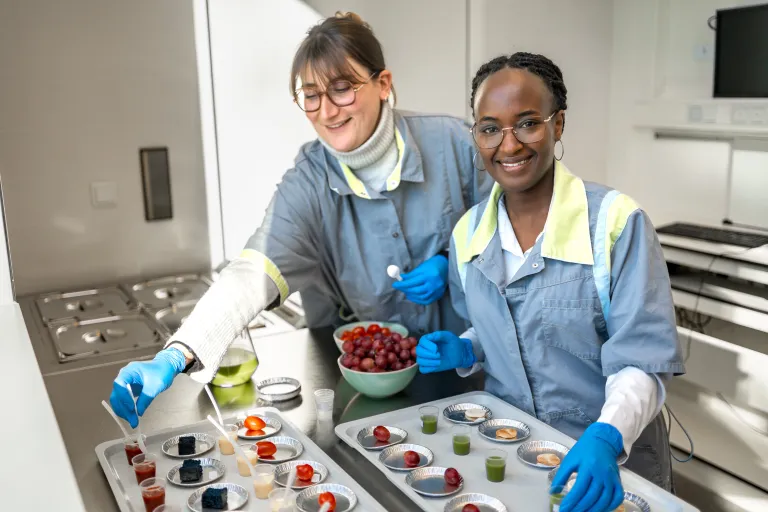
Hands-on sessions where you work with real food products, equipment and analytical techniques; from emulsions to enzyme kinetics. - Group projects
You’ll collaborate with fellow students on real life cases or research assignments, improving both your teamwork and communication skills. - Company visits
You’ll visit innovative food companies or research institutes to see how theory is applied in practice. - Thesis research (year 2)
You’ll conduct independent scientific research on a topic of your choice, guided by a WUR supervisor. Often part of ongoing research projects. - Internship (year 2)
A 4- to 6-month placement at a company or institute, in the Netherlands or abroad, where you apply your expertise in a professional environment.
During your studies, you will receive guidance from your study adviser, your thesis supervisor and from the internship coordinator. Your study adviser will assist you in the process of choosing the right core and domain courses, electives and thesis-preparatory courses for you. Your thesis supervisor will be a staff member of one of the chair groups related to this MSc programme, that will supervise you during your 24-week thesis period. Besides a study adviser and thesis supervisor, you will also be guided by an internship coordinator to help you find a company that suits your learning goals and ambitions.
- Master's in Food Quality Management
This study programme offers an integrated approach to the study and assessment of quality processes in the food industry. Quality is naturally a part of product development, offering similarities to Food Technology, but the focus of Food Quality Management is less on the product itself. - Master's in Food Safety
This study programme focuses on microbiology, toxicology, and legislation. These essential elements are shared with Food Technology, but Food Safety focuses less on the product than Food Technology. - Master's in Biotechnology
Biotechnology and Food Technology are members of the same family, they differ however in terms of scope and their applications. Where Food Technologist focus completely on Food Products, Biotechnologist could also study drugs, vaccines or biobased materials. Within Biotechnology students can specialise in Food Biotechnology and within the Food Technology programme students can follow courses related to Biotechnology. - Master's in Nutrition and Health
Food Technology is primarily about food production, how can we use microbial, chemical and physical processes to create the food products that we want? Nutrition and Health on the other hand studies the effects that occur in the human body after consumption of food. The two disciplines overlap; in both programmes, students you can learn the basics from the other programme. Interested in sensory science? This topic could be studied from within both programmes. - Online Master's in Food Technology
This is the online version of this study. The master's specialisation is designed as a part-time study, which gives you the flexibility to combine study and your professional career. The programme will take between 3 and 4 years to complete, depending on the effort and time you invest. The programme will take 3- 4 years to complete depending on the effort and time you invest. - EMFS
The European Master's in Food Studies is a specialisation of the Master's Food Technology. The EMFS is a collaboration between four European Universities and several Food Industry Partners.
Check more information on Studiekeuze123.nl.

Chat with Students & Alumni
Connect with students and alumni and get honest insights about their experiences.
Students about this programme
4.1/5
Student Satisfaction Score (Studiekeuze123)151
Number of first-year students (Studiekeuze123)4.2/5
Atmosphere (Studiekeuze123)4/5
Engagement & contact (Studiekeuze123)Life after this master’s
Graduates from food technology currently find jobs quite easily all over the world, especially in the Netherlands and Western Europe.
Graduates find a job in either one of the food industries, the government, universities or institutes. Around 10% of the graduates will pursue a PhD degree.
Student Career Services facilitates WUR students towards the labour market. If you need help in your orientation towards your future career.
Good to know
Interested in the master's programme Food Technology? Find out whether your knowledge and skills match the entry level of the programme.
Purpose and reason for the admission requirements
The admission requirements are defined in such a way that the students should be able to successfully complete the master's programme Food Technology nominally within two years.
In order to comply, the student needs to have sufficient academic knowledge and skills in the area of food technology. This entails a solid background in physics, microbiology, (bio)chemistry, organic chemistry as well as mathematics and scientific research skills. You also need to have a background in food science courses, like food physics, food chemistry, food microbiology, food process engineering, food quality, and be able to analyse problems related to food in a quantitative way. This is to ensure that the student has a solid basis for the more advanced studies in the master's programme, because the programme builds further upon the knowledge from the bachelor Food Technology.
The criterion used for admission is:
a WUR BSc degree in Food Technology, Biotechnology, or equivalent.
The norm for this equivalence is:
an assessment of the student's expertise in the following topics:
- Food Sciences (at least food chemistry, food engineering, food microbiology, and food physics)
- Mathematics (linear algebra, calculus) applied to food technological problems
- Basics in statistics
- Not all topics mentioned need to be mastered at the same level; they will be weighed by the Admission Board per individual application.
Method of assessment whether this norm is met:
- Transcript of records displaying the content of previous course subjects and project work;
- Curriculum vitae displaying relevant work, internship and/or project experience on an academic level in a relevant field if applicable.
Scores attributed by the Admission Board
Admitted / not admitted / admitted under condition obtaining the BSc or MSc degree / not admitted with offer of pre-master's.
Ready to start your application process? Find everything you need to know about Application & Admission before applying for a master's.
For more information about this specific programme's admissions criteria, download the admissions manual from the Master's in Food Technology.
It is not possible to apply for a pre-master's for the MSc in Food Technology. It may only be offered to you by the Admission Board when you apply for the MSc in Food Technology (online) programme. The pre-master's is only offered in case the applicant meets the general requirements and lacks specific knowledge in one of the mentioned areas, but never to compensate for the GPA requirement (7/10 or equivalent).
The Admission Board may allow and/or suggest compensation of knowledge gaps by:
- a GPA≥7.0* for the previous education for small discrepancies, as new knowledge is sufficiently easily acquired;
- a GPA≥7.0* and an individual pre-master's programme for larger discrepancies that can be compensated in ≤30 ECTS and one year of study.
*Check the Application & Admission page for master's for the International credentials evaluation guide for international equivalencies to a Dutch GPA>7.0. This guide includes compensating factors for a slightly lower GPA the Admission Board may include in their judgement.
Contact us through the contact button above to discuss the possibilities of a pre-master or how to mitigate knowledge gaps if you are still in the process of obtaining your degree.
Find out more about enrolment and fees of a pre-master's programme.
Admissible study programmes
Graduates from study programmes that may meet the knowledge requirements for Food Technology are for example: Food Engineering, Food Science (& Technology), Gastronomical Sciences, and Dairy Science & Technology.
Programmes with knowledge gaps
Study programmes whose students often have to follow additional courses during the previous study programme or a pre-master to fulfil the knowledge requirements are for example: Chemical Engineering, Culinary Sciences and Post-Harvest Technology.
Students from the BSc 'Voedingsmiddelentechnologie' of the HAS University of Applied Sciences may be directly admissible. The terms of their admissibility is presented during the annual on-site information session.
Studying in the Netherlands costs money. Curious to see what you should expect? All information about the costs of this programme can be found on tuition fees and study finances.
Outside of your study at WUR, you will most likely fill your day with other fun activities in and outside of Wageningen! Before you know it, you will be hanging out with your roommates, picnicking at the Rhine, visiting the market, or attending one of the many sport activities! Discover everything about student life in Wageningen.
Questions about this study?
Do you have questions about the programme Food Technology? Don't hesitate to send a message to one of the study advisers.
Discover WUR


Discover all Master's programmes at Wageningen University & Research
Follow Wageningen University & Research on social media
Learn more about the university and follow all our activities and student stories on social media.