Master’s in Water Technology (joint degree)

What to expect
Facts & figures- Nature, Technology
- Full-time
- 2 years
- English
- Wageningen
Is this master’s right for me?
Improvement of seawater desalination using innovative membranes and smart design, closing nutrient cycles by recovering phosphates from animal manure, storage of energy with a minimal environmental impact and the removal of micro-pollutant using smart UV-technology are some examples of technological innovations within the field of water technology. Have you become curious? Then, start this master's programme and a career in the field of water technology.
What makes this programme unique?

Inspiring environment
Study in an inspiring environment at the heart of the Wetsus laboratories and its excellent facilities in the capital of Water Technology.

Expert teaching
Learn from the excellent teaching staff from three highly regarded Dutch universities: Wageningen, Twente and Groningen.

Professional network
Gain access to professionals within an extensive network of companies in the industrial and public sectors.

Multidisciplinary and hands-on curriculum
Combines scientific rigour (chemistry, microbiology, transport phenomena, etc.) with engineering design (reactor and membrane processes), computational tools, and business case development.
What you will learn
The Master’s Water Technology is a multidisciplinary programme with a clear scientific and technological approach, embedded in a top research environment. Students learn to develop and apply sustainable innovations and optimisations, and to create new insights within the broader framework of resource recovery, healthy water, drought resilience, and fair and sustainable water. Courses include chemistry, microbiology, water treatment and reactor design. WUR, the University of Twente and the University of Groningen offer this master’s programme as a joint degree. The programme is taught in the capital of Water Technology Leeuwarden at the Wetsus institute, a centre for collaboration between companies all over the world and European research institutes.

You will learn to:
- Gain advanced scientific knowledge in environmental biotechnology, process, and chemical engineering.
- Design and apply sustainable technical solutions for water treatment, resource recovery, and energy production.
- Conduct independent experiments and research in water technology with academic rigour and integrity.
- Integrate theory and practice to address complex global water challenges.
- Communicate research results and innovative ideas effectively across scientific and professional fields.
Your courses
The Master's in Water Technology is a two-year study programme and encompasses 120 credits. The programme starts annually in September, and after graduation, students receive their MSc in Water Technology (joint degree). Details on all courses within this programme can be found in the Study Handbook.
The programme knows a common structure for all students. In year one, the programme has a single learning pathway, followed by an individual part in year two. As opposed to the other programmes of the Wageningen University, the Master's in Water Technology consists of four 15-credit periods. All periods last ten weeks, comprising all learning activities and examinations.
For more in-depth information about this programme and the WaterCampus in Leeuwarden, or to get in touch with the study programme director or current students, visit the external Water Technology website.
The programme starts with the course Water Technologies in Global Context (5 ECTS), in which students explore global water challenges in an international context. The course considers these challenges within the broader framework of growing scarcity of materials, energy and its associated pollution, also in relation to the type of country: low-income, emerging-income and high-income countries.
Subsequently, the programme continues with four courses (20 ECTS), which reflect on the multidisciplinary character of the current developments within the domain of water technology, and in which students specialise in scientific knowledge of various relevant disciplines. The focus is on scientific knowledge of natural and physical theories and on research applications in the overlap areas of two or more disciplines. These courses include a compulsory course on Colloid Chemistry and two compulsory courses, selected from Transport Phenomena, Physical Chemistry, and Water Microbiology, depending on the educational background of the student.
The programme continues with four courses (20 ECTS) in water engineering: Chemical Reactor Design, BioReactor Design, Biological Water Treatment & Recovery Technology and Multi-component Mass Transfer in Membrane Processes. The central topic is the integration of water treatment & recovery concepts and design issues when performing reactors. Students apply acquired knowledge and understanding of the previous courses to start the design of new technologies, and they learn to produce the best solution for a certain problem. Topics relate to conversions and reactor selection, reactor design and membrane science.
The first year is completed by two compulsory courses. The course Computational Methods in Water Technology has its focus on process dynamics and reactor networks (5 ECTS), and in the course Business Case Design project (10 ECTS), students work in teams on the development of a business case. In this part, called sustainable technology, students learn how to integrate the results from the engineering part in the context of society and business and encounter the complexity in practice.
The second year comprises an MSc thesis (36 ECTS) and an MSc internship (24 ECTS). The topics of the thesis and internship should be within the scope of the mentioned main research areas.
Research in the MSc Water Technology
The research part of the programme trains students to work independently, apply their skills, and deepen their expertise in a topic that matches their interests and career goals.
The master’s thesis is central to this phase. It requires students to:
- Critically analyse, discuss, and summarise a research topic.
- Join ongoing projects at Wetsus, where they benefit from cutting-edge labs, infrastructure, and close guidance from active researchers.
- Demonstrate both their learning progress and their ability to carry out high-level research.
Because water technology is inherently multidisciplinary, thesis projects may involve collaboration across multiple chair groups.
Main research areas include:
- Sustainable water supply
- Wastewater treatment and reuse
- Development of new water sources
- Resource recovery and energy production
This MSc covers a broad range of disciplines and possible work fields. In your second year, it is up to you to choose a thesis and internship that suits you.
The master’s Water Technology is a multidisciplinary programme with a clear scientific and technological approach embedded in a top research environment. Students learn to develop, propagate and apply sustainable innovations and optimisations, and create new insights within the broader framework of the growing scarcity of raw materials such as water and mineral nutrients, and take on the chances that our 'waste’ offers in the form of new resources.
At WUR, we see you as more than just a student number. That’s why we offer more access to lecturers, study advisers, and student counsellors than most universities in the Netherlands. This level of support reduces the risk of dropping out while adding a personal touch that enriches your academic journey reflecting our sincere commitment to your success. As we are located in Leeuwarden, we host our support there too.
- Master's in International Land and Water Management, Wageningen University and Research
The Master of Science in International Land and Water Management is oriented towards management, planning, stakeholder interaction, and socio-technical systems rather than technology alone. Students in International Land and Water Management study the theme of “Water, Society and Technology” among its specialisations, but always with a strong emphasis on balancing human, environmental, and socio-economic dimensions such as flood management, adaptation to climate extremes, land use, and hydrology. The Master of Science in Water Technology is much more narrowly focused on treatment technologies, recovery of raw materials such as nutrients and metals, purification processes, and reactor and process engineering. International Land and Water Management focuses more on how water interacts with land systems, communities, governance, and integration of technologies into landscapes. For students who wish to apply water technologies in real-world systems, International Land and Water Management provides greater breadth, while Water Technology provides deeper technical expertise. - Master's in Biosystems Engineering, Wageningen University and Research
The Master of Science in Biosystems Engineering offers several thesis tracks, including Environmental Technology. This track overlaps with Water Technology in designing processes or systems that reuse waste materials, manage environmental flows, and include water treatment or recovery of nutrients. However, Biosystems Engineering is primarily oriented towards agriculture, food production, biobased systems, and the application of technology in rural and food-system contexts. The Environmental Technology track is only one of several specialisations, so the emphasis on water process engineering is smaller. In addition, students may choose to specialise in areas such as logistics, remote sensing, or information technology. Compared to Water Technology, Biosystems Engineering provides a wider variety of pathways but less concentrated exposure to water process engineering and the recovery of resources from wastewater. - Master's in Aquaculture and Marine Resource Management, Wageningen University and Research
The Master of Science in Aquaculture and Marine Resource Management focuses on aquatic ecosystems, life sciences, marine resources, ecology, governance, and the sustainable use of marine life, including seafood and ecosystem services. Its specialisations include Aquaculture, Marine Governance, and Marine Resources and Ecology. There is some overlap with Water Technology in areas such as water quality, aquatic biology and ecology, and managing human impacts on water systems. However, this programme does not centre on chemical or bioprocess engineering for treatment, the recovery of raw materials from wastewater, or the design of reactors and biotechnological systems. For students passionate about marine ecology, coastal systems, species management, and marine policy, Aquaculture and Marine Resource Management is highly suitable. For those aiming at technological innovation in water treatment, purification, and resource recovery, Water Technology is more directly aligned.
For more information check Studiekeuze123.nl.

Chat with Students & Alumni
Connect with students and alumni and get honest insights about their experiences.
Students about this programme
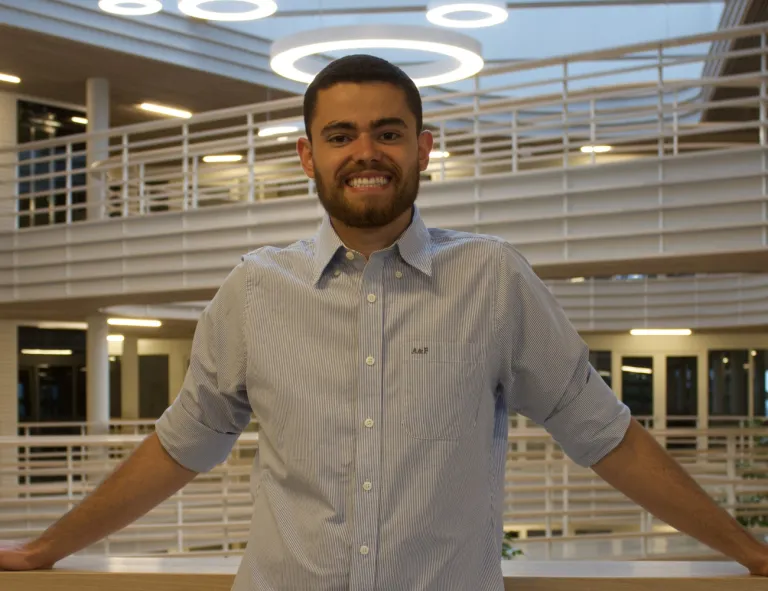
“I use the full width of knowledge from the master’s every day.”
4.3/5
Student Satisfaction Score (Studiekeuze123)20
Number of first-year students (Studiekeuze123)4.6/5
Atmosphere (Studiekeuze123)4/5
Engagement & contact (Studiekeuze123)Life after this master’s
Our students have access to professionals within an extensive network of companies in the industrial and public sectors. Participating in several platform activities, our students become acquainted with the work field. Students are accepted as interns by potential employers in a variety of companies during their compulsory internship. Students apply knowledge and skills acquired during their study, and also acquire relevant new knowledge, insights and skills through work experience. Students learn to work independently and develop a feeling for the context of the organisation. The work has to be carried out at an academic level. Reflection on the practices of the organisation and on the student’s own functioning is an important component. Internships also offer students the opportunity to reflect on their career after completion of the studies and to get a sense of the areas of expertise and competencies they further need to develop. Students can do their internship in the Netherlands and abroad.
If you need help in your orientation towards your future career Student Career Services facilitates students towards the labour market.
Good to know
Admission requirements
Students holding a bachelor's degree in the following are directly admissible:
- The student holding a bachelor’s degree in Biotechnology from Wageningen University & Research;
- The student holding a bachelor’s degree in Chemical Engineering from any university in the Netherlands;
- The student holding a bachelor’s degree in Industrial Engineering & Management from the University of Groningen;
General requirements for enrolment in the joint MSc Programme Water Technology are:
- A BSc degree (or equivalent) in a field of science relevant to the field of water technology
- A Grade Point Average (GPA) for the BSc of at least 70% of the maximum grade
- Fluency in English, both written and spoken
Learn more about the requirements for admission (e.g. the English language proficiency).
Relevant BSc degrees
Applicants for the MSc programme Water Technology should have a relevant BSc degree in chemical engineering, biotechnology, environmental engineering or another natural/technological oriented field related to water. A Dutch bachelor's degree (HBO) related to one of the topics mentioned above is also relevant for admission to the MSc programme Water Technology.
An admission committee will judge every application on an individual basis. The basic intention is to admit students who are expected to be able to complete their degree in the nominal study time of two years. The presence, level and result of relevant courses in mathematics, physical chemistry, chemistry, life sciences and engineering will be judged. Furthermore, some affinity with the field of water (technology) is required e.g. to show by your thesis or internship topic, publications or working experiences.
Ready to start your application process? Find everything you need to know about Application & Admission before applying for a master's.
Check the Application & Admission page for master's for the International credentials evaluation guide for international equivalencies to a Dutch GPA>7.0. This guide includes compensating factors for a slightly lower GPA the Admission Board may include in their judgement.
Please contact us to discuss the options available to help you choose the right subjects if you have not yet completed your studies.
Explore more about Tuition fees and study finances.
Wageningen offers a diverse, enjoyable, and amiable student community. Despite being a small town, you get to know people from all over the world because of Wageningen University & Research's global atmosphere. Everything in town is relatively accessible by bicycle, and the campus is contemporary and green. Whether it's a sporting event, a party, or a laid-back evening with friends at one of the student associations, there's always something going on. Additionally, there are parks, forests, and a river nearby, so if you enjoy the outdoors, you're in the right area. It's a fantastic combination of learning, socialising, and taking in the scenery.
Explore more about Student life in Wageningen.
Questions about this study?
Have questions about the programme? Feel free to reach out to the study adviser, we’re happy to help!
Discover WUR


Discover all Master's programmes at Wageningen University & Research
Follow Wageningen University & Research on social media
Learn more about the university and follow all our activities and student stories on social media.