The chemical-free strawberry is getting closer
- Kirsten Leiss
- Researcher plant health
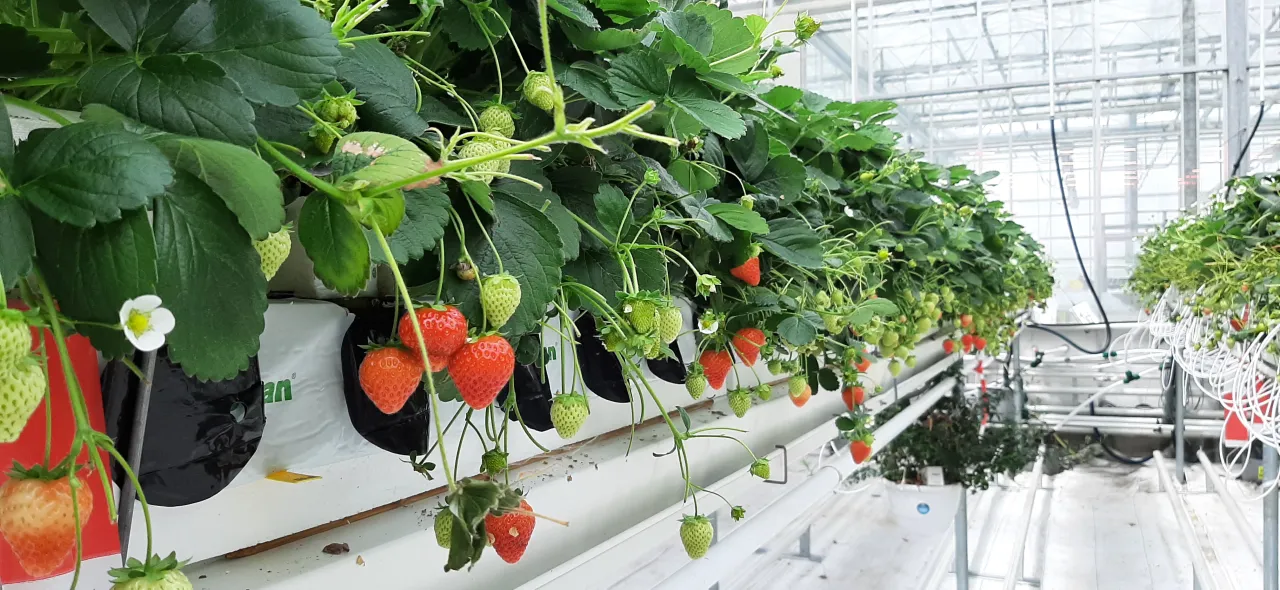
“We’ve shown that it’s possible: a healthy strawberry grown with almost no chemicals.”
With a resilient cultivation system that makes optimal use of natural pest control, smart growing techniques and UV-C light, WUR researchers have managed to drastically reduce the use of crop protection products in strawberry cultivation.
The search for resilient strawberry cultivation
Growing healthy strawberries without chemical crop protection – eight years ago, that still seemed like a dream. Strawberries are highly sensitive to diseases and pests, and the use of pesticides in the sector was high. This raised concerns about residues on fruit – possible “cocktail effects” – and the emission of crop protection products into the environment.
Greenhouse experts from Wageningen University & Research (WUR) therefore took up the challenge. Together with breeders, suppliers, advisory organisations and growers, they designed a completely new cultivation system based on four pillars:
- A clean start – using disease-free seed and controlled propagation conditions.
- Strong varieties – selecting cultivars less susceptible to diseases such as Phytophthora.
- Optimal growing conditions – cultivation on sustainable substrates with precise control of climate and irrigation.
- Smart environmental factors – using banker plants that provide habitat and food for natural enemies of pest insects, and UV-C light to keep mildew under control.
“By bringing all these elements together in one resilient cultivation system, we’ve been able to significantly reduce the use of chemical crop protection products,” says project leader Kirsten Leiss. “That brings us much closer to a strawberry cultivation system without chemistry.”

From experiment to inspiration
The results have attracted great interest within the strawberry sector. However, because of the investments involved, growers are not expected to adopt the entire system at once, says researcher Johanna Bac-Molenaar. “It’s about the way of thinking. We’ve shown what is possible. Growers can gradually apply different elements on their farms – for example, building populations of natural enemies in greenhouses using banker plants and supplementary feeding, or using self-driving platforms equipped with UV-C lighting.”
In the meantime, several breeders are working on F1 hybrid varieties grown from seed. Seed propagation in a protected environment ensures a clean start. Leiss explains: “New varieties such as Limore One show that yields can compete with traditional runner-grown cultivars. This part of the system is now slowly becoming ready for practice.”
Working together for sustainable growth
By combining expertise in plant health, breeding and cultivation technology, an important step has been taken towards a resilient and future-proof strawberry cultivation system in the Netherlands. The research is part of the national Knowledge Boost Sustainable Crop Protection and Pollinators programme, commissioned by the Ministry of Agriculture, Fisheries, Food Security and Nature (LVVN).
The aim of this eight-year programme is to minimise the dependence on crop protection products and ensure that substances which are on the EU’s Candidates for Substitution list will no longer be needed. Within this programme, researchers, suppliers, advisers and growers work together on sustainable cultivation systems for several crops – from apple and leek to lily and strawberry.
The impact of the project on the strawberry sector is significant: reduced use of chemicals leads to cleaner surface and groundwater, healthier soils and fruit that meets the strictest standards. Leiss says: “We’re not finished yet, but the foundation has been laid. And the best part is that we’ve shown sustainability and profitability can go hand in hand.”
From greenhouse to open field
Although the trials were carried out in greenhouses – where most strawberries are now grown in the Netherlands – the impact reaches further. The insights from this project can also be applied to open cultivation systems, such as strawberries grown on tabletops.
Value for the sector
The research results offer growers in both greenhouse and open-field systems practical tools to replace chemical crop protection with integrated strategies – maintaining yields, reducing emissions and strengthening plant health. The elements can be applied step by step, allowing companies to scale up gradually and meet the stricter demands of retailers and policy.
- Integrated system approach
- From seed to harvest: biology, technology and cultivation expertise combined.
Proven in greenhouse and practice:
- Developed and tested in WUR’s experimental greenhouses in Bleiswijk; directly applicable for growers.
- Independent partner: collaboration with industry and the Dutch government; objective knowledge, transparent results.
Want to make impact together?
Do you want to work together on pesticide reduction in greenhouses? Contact us.

Follow all plant research from Wageningen University & Research
Stay up-to-date on our research through LinkedIn