Bachelor’s in Food Technology

What to expect
Facts & figures- Food, Technology
- Full-time
- 3 Years
- English
- Wageningen
Is this bachelor’s right for me?
Wondering if Food Technology is right for you? If you're excited about creating innovative, sustainable food products and solving real-world challenges in health, safety, and quality, this study could be your perfect fit. Learn about ingredients, packaging, and more to shape the future of food.
Curious? Come experience it for yourself during a Taster Day.

Get to know the Food Technology programme!
What makes this programme unique?

International reputation
The only Food Technology program in the Netherlands at university level with an excellent international reputation.

Practical and relevant
You can immediately test what you learn. You'll use your scientific knowledge for real-world products that you'll see in everyday life.

Lots of freedom of choice in specialization
During the program, you'll learn which subjects and areas suit you best. You'll have plenty of opportunities to deepen or broaden your knowledge.

We want WUR!
The food industry is one of the largest and most innovative sectors in the world. Many companies are eager to hire people like you.
What you will learn
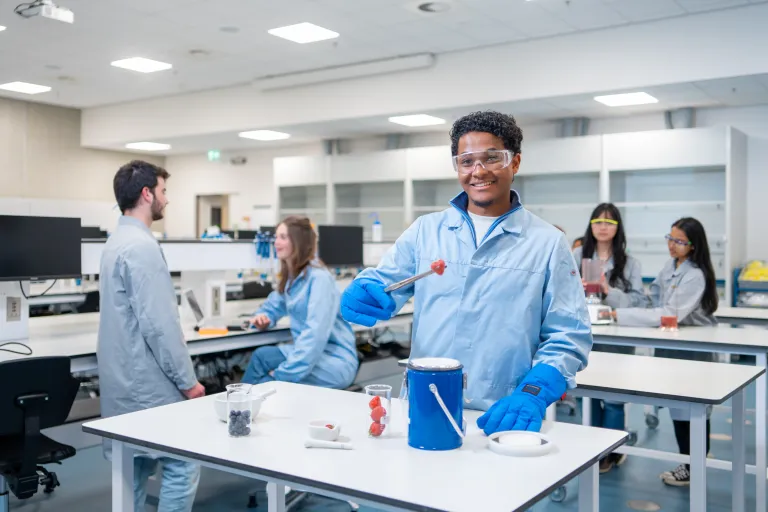
In the BSc Food Technology programme, you’ll gain a strong scientific foundation while learning how to develop, improve, and assess food products. From ingredient functionality to food safety and quality, you’ll explore every stage of the food production chain.

You will learn
- You'll apply chemistry, physics, and mathematics in a practical way.
- You'll learn all about nutritional values and the properties of ingredients.
- You'll test and improve recipes yourself.
- You'll learn about food safety, shelf life, packaging, and logistics.
- You'll contribute to important innovations in food, such as the protein transition.
Your courses
Building the Foundation: In your first year, you’ll establish a solid scientific foundation with courses in mathematics, chemistry, biology, and physics, all tailored to food applications. You’ll also dive into food-specific subjects early on, starting with Introduction to Food Technology, which includes excursions and orientation in the field. Other key courses include Cell Biology, General and Organic Chemistry, and Microbiology & Toxicology, giving you both theoretical and hands-on lab experience. You'll also develop soft skills through courses like Presentation Skills, and apply physics and thermodynamics in a food context during Physical Chemistry for Food Scientists.
Deepening Food Technology Expertise: The second year focuses fully on food-specific disciplines. You’ll learn to apply scientific principles directly to food challenges in courses such as Food Microbiology, Food Chemistry, and Food Production and Preservation. Physics and engineering come into play through Food Physics and Food Engineering, where you explore how structures like emulsions and gels affect product texture and stability. Courses like Food Hazards, Packaging and Design, and Quality Systems Operations train you to ensure food safety and quality. You’ll also develop your own food product during Food Properties and Function, integrating everything you’ve learned so far.
Your final year allows you to tailor your studies through free electives: you can deepen your food technology knowledge or branch out into new areas, even at other universities or abroad. The only compulsory course, Case Studies, lets you tackle real-world industry problems in a team, applying all disciplines of food technology. Finally, you’ll carry out a graduation thesis, where you independently conduct a research project under the supervision of a PhD student or postdoc, and write a professional report, an important step toward your future career or MSc studies.
In your third year, you have plenty of space to shape your own programme. You can follow a minor, like Foods of Animal Origin, Psychobiology of Eating behaviour. You can also choose individual elective courses or do an internship. Want to go abroad? That’s possible too! Your study adviser will help you find the option that suits you best.
See an overview of all minors.
The BSc Food Technology programme combines theory with practical experience through varied teaching methods and a structured academic calendar. Each year is divided into six teaching periods. Most periods last eight weeks, with two subjects running in parallel, followed by a week of self-study and a final exam week. Periods 3 and 4 are shorter, lasting four weeks and usually focusing on one subject.
You’ll earn 180 ECTS credits over the programme, with most courses worth 6 ECTS. Expect around 24 contact hours per week, using different learning formats:
- Lectures : Learn new concepts in large-group sessions.
- Tutorials : Work in smaller groups to deepen understanding with instructor support.
- Project-Based Learning : Collaborate on real-world cases to solve food tech problems.
- Practicals & Computer Sessions: Apply theory in lab or computer-based settings.
- Excursions: Visit food companies and connect theory to industry practice.
In addition to contact hours, private study time allows for review, preparation, and project work.
At WUR, we believe personal guidance and contact are very important. That's why we have significantly more support staff (lecturers, study advisers, and student counsellors) available to help you progress through your studies than at other universities in the Netherlands. This reduces the risk of you dropping out. This personal touch also enhances your learning experience.
In addition to the Bachelor’s program in Food Technology, Wageningen University & Research offers two related programs: Nutrition and Health and Biotechnology.
- BSc Nutrition and Health
Food Technology focuses specifically on the production and development of food products, while Nutrition and Health focuses more on the effects of these foods on the human body. Although there is little overlap in the courses, Food Technology students do gain a basic understanding of Nutrition and Health, and vice versa. In the Master's programs, both programs collaborate in the specialisations of Sensory Science and Food Digestion and Health. By adding the minor in Food Technology to the Bachelor’s curriculum, Nutrition and Health students can usually progress to the Master's program in Food Technology. - BSc Biotechnology
The overlap between the Food Technology and Biotechnology programs is primarily in the core subjects such as microbiology, physics, and chemistry. The differences lie primarily in the applications; while Food Technology focuses primarily on food production, Biotechnology focuses more on medical applications, such as medicines.
Wondering what it’s like to study Food Technology at Wageningen University & Research? Try the online trial classes with mini-lectures and interactive assignments. This way you can find out if the content matches your interests.

Taster Day
Join a student and experience a study, WUR and student life.
Students about this programme
4/5
Student satisfaction (Studiekeuze123)103
Number of first-years4.1/5
Atmosphere (Studiekeuze123)3.9/5
Involvement & contact (Studiekeuze123)Life after this bachelor’s
Many students pursue a master's degree after completing their bachelor’s program. This will help you become a true expert in your field. These master's programs are a good fit:
Another Wageningen master's program is also an option. In that case, in the third year of your bachelor’s program, you choose electives that will facilitate your entry into your preferred master's program. Your academic adviser will help you determine this route, ensuring you can start without delay. Consider, for example:
The world of food technology is vast, and there are many career opportunities. Consider:
- Product Developer – developing new snacks or plant-based alternatives at companies like Unilever or Friesland Campina.
- R&D Specialist – researching taste, texture, and shelf life at companies like Nestlé or Mars.
- Quality Manager – monitoring food safety and sustainability at producers or the Netherlands Food and Consumer Product Safety Authority (NVWA).
- Process Engineer – improving production lines at major players like Heineken or Coca-Cola.
- Teacher - teaching chemistry at high school or Food Technology in higher education.
- Consultant – advising companies and governments on healthy and sustainable food, for example at DSM or PwC.
Student Career Services facilitates WUR students towards the labour market. If you need help in your orientation towards your future career.
Good to know
To be admitted to the bachelor’s programme Food Technology, you should have studied mathematics, chemistry and biology or physics.
Have a look at the Application & Admission page for starting at Wageningen University & Research and check whether your prior (international) education qualifies you for this bachelor’s programme.
Are you a Dutch student? Switch the language to Dutch at the top of these pages to view the admission information that applies to you.
Studying costs money. Curious about the costs involved? You can find all information about the costs of this program on tuition fees and study finances.
Wageningen offers a diverse, enjoyable, and amiable student community. Despite being a small town, you get to know people from all over the world because of Wageningen University & Research's global atmosphere. Everything in town is relatively accessible by bicycle, and the campus is contemporary and green. Whether it's a sporting event, a party, or a laid-back evening with friends at one of the student associations, there's always something going on. Additionally, there are parks, forests, and a river nearby, so if you enjoy the outdoors, you're in the right area. Discover everything about student life.
Questions about this study?
Do you have questions about the Bachelor’s in Food Technology? Contact the study adviser.
Discover WUR


Discover all Bachelor's programmes at Wageningen University & Research
Follow Wageningen University & Research on social media
Stay up-to-date and follow all activities and stories of our students on our socials.